Mobile gaming has long been ruled by bright colors, constant notifications, and reward loops tuned to the second. Puzzles ask for something different. They want a few minutes of focus and the patience to let an answer arrive. That trade-off once felt niche. Now it feels like relief. Players who shrugged off logic games are coming back to them, treating them as an antidote to the rest of their screen time.
Part of this comes from how people approach entertainment in general. The same audience that browses curated streaming libraries, reads news aggregators, or checks reviews on sites like oscarspin before trying a new platform also wants puzzle play to feel considered rather than chaotic. People want quality and clarity, not louder design. Hub-style puzzle apps arrived at the right moment to meet that mood.
What Makes a Puzzle Game Worth Keeping on Your Phone
Anyone who has deleted a puzzle game after three days knows the feeling. It looked good in the store, but something was off. Too many ads. Too much grinding. A difficulty curve that flattened too soon. The titles that survive on a home screen share a few qualities, and most have less to do with graphics than with respect for the player’s time.
“The best puzzle designers don’t try to addict you. They try to give you a satisfying problem and then get out of your way.”
— a sentiment echoed across mobile gaming forums for years
A few traits set the keepers apart from the deletions:
- Clean interfaces that don’t bury the puzzle under menus
- Offline play, so a subway tunnel doesn’t end the session
- Honest monetization without surprise paywalls mid-level
- Difficulty that scales gradually rather than spiking
- Replay value through daily challenges or generated boards
- A sense of progress that doesn’t rely on artificial streaks
Design Choices That Quietly Matter
Small details add up. Haptic feedback when a tile locks into place. A satisfying sound when a sudoku grid completes. The way a crossword highlights an intersecting clue. These touches turn a passable game into one that earns a permanent spot on a phone. Developers working across Android and iOS have learned that this kind of polish is no longer optional.
From Scattered Downloads to a Single Library: The Hub Approach
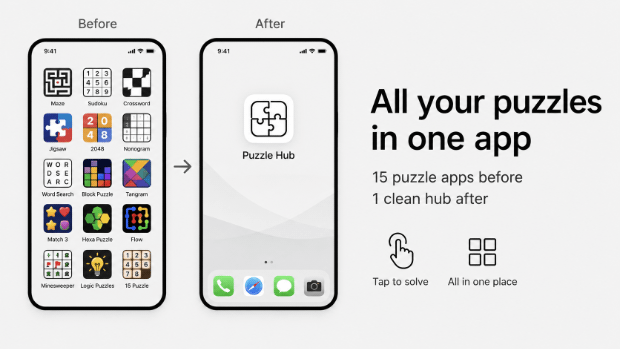
A puzzle fan once needed fifteen separate apps. One for sudoku, one for crosswords, one for jigsaws, another for nonograms, and so on. Each came with its own account, its own ads, and its own update schedule. The hub model changes that math. It gathers a curated selection of formats under one roof. Switching between games gets easier, and trying a new category no longer means another download.
| Puzzle Type | Typical Session Length | Skill Focus | Hub App Suitability |
|---|---|---|---|
| Sudoku | 5–15 minutes | Logic, deduction | Excellent |
| Crossword | 10–30 minutes | Vocabulary, lateral thinking | Excellent |
| Jigsaw | 20–60 minutes | Pattern recognition | Good |
| Nonogram | 10–25 minutes | Spatial logic | Excellent |
| Word Search | 3–10 minutes | Visual scanning | Very good |
The appeal shows up after a week of use. Instead of chasing notifications across many icons, a player opens one app and picks a mood. A quick word puzzle on a coffee break. A longer logic challenge in the evening. Among the best puzzle games for iPhone and Android, the titles gaining traction tend to live inside these curated libraries rather than stand alone.
Why Curation Beats Volume
A hub with two hundred mediocre puzzles is worse than one with twenty strong ones. The apps gaining loyal followings have clearly been shaped by someone with taste. Someone who understands that a player’s time is limited, and that recommending a forgettable title costs trust.
Cognitive Habits, Commutes, and the Five-Minute Window
Modern attention spans get plenty of criticism, but the picture is more nuanced. People still focus deeply. They just do it in shorter, more frequent bursts. A puzzle that respects the five-minute window fits modern life in a way a forty-hour open-world game cannot. It needs to be solvable on a bus ride, pausable without penalty, and easy to resume later. This is why the best puzzle games Android players return to often favor short, self-contained challenges over sprawling progression systems.
“There’s growing interest in low-stakes mental engagement — activities that occupy the mind without demanding it.”
— observation drawn from recent commentary on digital wellness trends
Research on cognitive habits suggests that varied, moderate mental challenges may help keep the mind sharp. The evidence is more cautious than the headlines, but the subjective benefit is clear. Many players describe puzzle sessions as genuinely restful in a way that scrolling rarely is.
A few patterns come up when people explain why they keep a puzzle hub installed:
- It fills small gaps in the day without demanding commitment
- It offers a sense of completion that open-ended apps rarely give
- It doesn’t compete for emotional energy the way social media does
- It still works in airplane mode, which matters more than people admit
- It can be shared with family members across different ages
- It rarely produces regret, unlike many other mobile habits
Where Puzzles Meet the Wider World of Digital Play
The instincts that pull people toward a good puzzle hub show up elsewhere too. People prefer skill over chance, value clean design, and want a contained experience. Online card rooms, strategy-based browser games, and some casino platforms have noticed that their most engaged users overlap with puzzle players. The common thread is decision-making. People enjoy environments where their choices clearly shape the outcome.
| Player Priority | Puzzle Apps | Other Digital Platforms |
|---|---|---|
| Skill expression | Central | Variable |
| Session control | Strong | Depends on platform |
| Visual polish | Increasingly high | Generally high |
| Offline availability | Common | Rare |
This overlap doesn’t mean the categories merge. A sudoku grid and a poker table belong to different worlds, and most players keep them apart. The shared preference is more subtle. People want digital experiences that feel considered rather than manipulative, and developers across the spectrum are starting to listen.
What began as a quiet preference for thoughtful mobile games has grown into something closer to a cultural shift. Puzzle hub apps sit at the center of it. They offer one well-edited space for the games people actually want to keep on their phones. For anyone tired of the noise, they’re worth a closer look — not as a trend, but as a small, sensible corner of the digital day.